First-Ever APEC Youth Scholars Forum Opens in Shenzhen
The APEC Study Centers Consortium Youth Scholars Forum opened in Shenzhen on May 7. The forum was jointly hosted by the Chinese University of Hong Kong, Shenzhen (CUHK-Shenzhen) and Nankai University’s APEC Study Center, with support from the Institute for International Affairs, Qianhai.
As part of the events marking China’s APEC Year, the forum is the first academic forum in the history of the APEC family dedicated specifically to young scholars. It marks the first time that young voices have entered the regional cooperation dialogue under the APEC framework in an independent and systematic way.
Themed “Forging New Drivers of Development: Youth, Innovation and a Sustainable Future”, the forum brought together young scholars from 13 APEC economies, including Australia, Chile, China, Hong Kong SAR, the Republic of Korea, Malaysia, Mexico, New Zealand, Papua New Guinea, Peru, the Philippines, Russia and Singapore. Senior officials from the APEC Secretariat also attended the forum, with scholars from Macao SAR specially invited to join discussions on new drivers of development in the Asia-Pacific region.
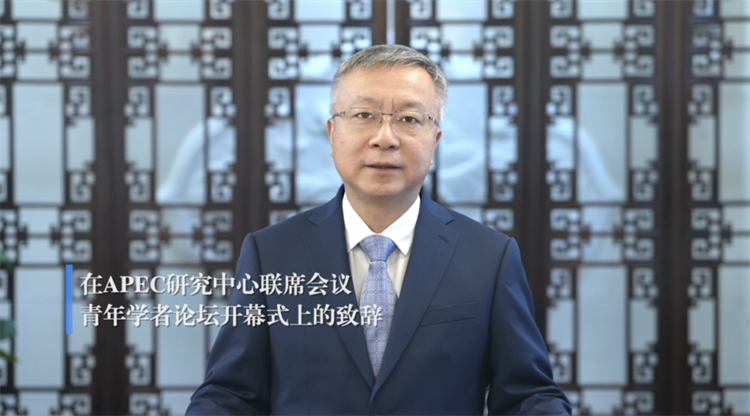
In a video address, Ren Youqun, Vice Minister of Education, encouraged young scholars from APEC member economies to become explorers of frontier technologies, practitioners of green development and promoters of mutual learning among civilizations. He called on them to contribute lasting youthful energy to building an open, inclusive and mutually beneficial Asia-Pacific community with a shared future.
More than 800 officials, experts and scholars attended the opening ceremony. They included Eduardo Pedrosa, Executive Director of the APEC Secretariat; Fernando Salas, Director of the Communications and Public Affairs Unit of the APEC Secretariat; Jiang Xiaojuan, a professor at the University of the Chinese Academy of Social Sciences, former Deputy Secretary-General of the State Council and Chair of the National Data Expert Advisory Committee; Ren Xianliang, Secretary-General of the World Internet Conference; Chen Yulu, President of Nankai University; Xu Zhongsheng, Counselor of the Department of International Economic Affairs at the Ministry of Foreign Affairs; Chen Qing, member of the Standing Committee of the CPC Shenzhen Municipal Committee; Ge Zhenjiang, Vice Chairman of the China Education Development Foundation; Chen Guangjun, Deputy Director-General of the Foreign Affairs Office of the People’s Government of Guangdong Province; Luo Bing, Director of the Shenzhen Municipal Talent Affairs Bureau; Xu Yangsheng, Chair of the Forum Organizing Committee and President of CUHK-Shenzhen; Zheng Yongnian, Vice Chair of the Forum Organizing Committee, Dean of CUHK-Shenzhen's School of Public Policy and Director of the Institute for International Affairs, Qianhai; and Liu Chenyang, Vice Chair of the Forum Organizing Committee and Director of Nankai University’s APEC Study Center. Wang Cong, Associate Vice President of CUHK-Shenzhen, presided over the opening ceremony.

In his remarks, Pedrosa reviewed APEC’s achievements over the past 37 years, noting that the organization has grown from 12 to 21 members, accounting for 37% of the global population and about 61% of the world's GDP. He said that young scholars represent a new wave of innovation and research, and they will bring fresh momentum to Asia-Pacific cooperation and academic development.

Chen Yulu delivered a video address, noting that the APEC Study Centers Consortium brings together universities and academic institutions from all 21 APEC members. He said that it serves not only as an important platform for academic and people-to-people exchanges among members, but also as a vivid example of APEC’s “family spirit”. On the occasion of China’s third APEC host year”, Chen said, Nankai University and CUHK-Shenzhen have jointly launched the forum to focus on “forging new drivers of development”. Through discussions on technology empowerment, regional economic integration, and educational innovation in the age of artificial intelligence (AI), the forum explores development pathways and the role of youth in a systematic way. He said that the forum represents a meaningful expansion and innovation in the APEC development process, providing a new platform and model for international exchange, regional cooperation and shared prosperity, while contributing intellectual momentum to APEC’s sustainable development. Chen also introduced Nankai University’s contributions to peace and development in the Asia-Pacific region through its APEC Study Center over the past three decades. He expressed hope that the forum would further deepen exchanges with partners from APEC members, help address common global challenges, and build greater consensus and stronger synergy for a closer and more united Asia-Pacific community.

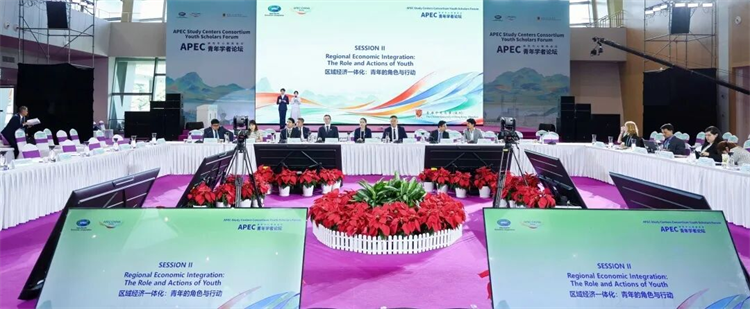


The forum featured four parallel sessions. “Empowering Innovation through Technology: Opportunities in AI and the Digital Economy” focused on how AI is reshaping the industrial landscape of the Asia-Pacific and explored technology-driven pathways toward shared regional prosperity. “Regional Economic Integration: The Role and Actions of Youth” examined how young people can take part in regional cooperation through research, policy advocacy, entrepreneurship and innovation. “Beyond the Classroom: AI-Driven Education and Conflicts with Traditional Paradigms” discussed the systemic impact of AI on traditional education models, as well as deeper issues of educational equity and generational change. “Toward a Green and Sustainable Future: Youth Perspectives and Initiatives” brought together young voices from across the Asia-Pacific to explore new opportunities for cross-regional green cooperation on climate action and sustainable development.
Nankai University’s APEC Study Center was established in 1995. It is a key research base for humanities and social sciences under the Ministry of Education, a council member of the China Council for BRICS Think Tank Cooperation, and a member of the Global South Think Tanks Alliance.
(Edited and translated by Nankai News Team.)

38 Tongyan Road, Jinnan District, Tianjin, P.R.China 300350 94 Weijin Road, Nankai District, Tianjin, P.R.China 300071
Copyright: Nankai University All Rights Reserved